Showing posts with label south down. Show all posts
Showing posts with label south down. Show all posts
Monday, 23 April 2012

Tuesday, 31 January 2012
The Enchanted Wood
Ebernoe Common
 Heavy snow-laden clouds seem to be propped up by the tall birch trees around the small Victorian red-brick church, and the occasional flurry of snow litters the car park with flecks of white.
To the east of the church a path runs south and then south east, made up in that ancient way of compacted rubble, slippery with mud, ice and beech mast. To the left is Furnace Field, in warmer times a favourite haunt of adders. Now, nervous fieldfares bolt out of hedges to snatch morsels from the iced-fingers of grass.
Further on, across a stream-bottomed valley there stands a restored brick kiln, a reminder that this which nature has reclaimed was once a centre of industry, where the sounds of hammers echoed for miles around, while ther forests flickered with fire.
 More evidence of this industrial past lies south-west of the church where a frozen furnace pond supports a small flock of mournful looking mallards. The pond sparkles like glitter has been strewn across it surface, and each clumsy
mallard footstep echoes from bank to bank.
More evidence of this industrial past lies south-west of the church where a frozen furnace pond supports a small flock of mournful looking mallards. The pond sparkles like glitter has been strewn across it surface, and each clumsy
mallard footstep echoes from bank to bank.
Great clouds of blue, coal and great tits engage in what appears to be a competition to throw over the largest leaf as they forage among the beach mast. Suddenly an old English sheepdog appears and sits obediently at my side. For a while we stand together in silence watching the birds before the voice of an unseen mistress calls him away, and with a glance over his shoulder he is gone.
Bemused I turn back to find the tits have left, and a solitary grey squirrel sits where they foraged, clasping a beech nut. I hear what I initially take to be a jay mimicking a buzzard, as they are known to do, when the call rises in volume, incessant and repetitive.
I scan the skies, the squirrel scampers up the nearest tree, and above two common buzzards appear. One is noticeably smaller than the other, who calls constantly. They glide only for short periods and at a low altitude, the cold air probably lacking the thermals they need for their familiar soaring displays.
 It is easy to see why in Scotland they are known as the 'tourist's Eagle' with their long fingery wings and gliding flight. After fifteen minutes or more of calling and circling they fly west into the weak sun and are lost over the beech trees.
Across the forest the repetitive beat of a drumming great spotted woodpecker sounds out, loud but unseen, pausing occasionally, waiting for an answer that never seems to come.
Paths criss-cross this ancient forest, tempting the explorer. They are the remnants of trackways that lead to the industrial sites that were once common here, some are hollow-ways, hundreds of years old. It is easy to get lost here, happy care-free lost of a child in an enchanted forest. Following any of the paths north leads to the church, or if not the road that leads to the church, where a welcome flask of soup waits in the car.
 Heavy snow-laden clouds seem to be propped up by the tall birch trees around the small Victorian red-brick church, and the occasional flurry of snow litters the car park with flecks of white.
To the east of the church a path runs south and then south east, made up in that ancient way of compacted rubble, slippery with mud, ice and beech mast. To the left is Furnace Field, in warmer times a favourite haunt of adders. Now, nervous fieldfares bolt out of hedges to snatch morsels from the iced-fingers of grass.
Further on, across a stream-bottomed valley there stands a restored brick kiln, a reminder that this which nature has reclaimed was once a centre of industry, where the sounds of hammers echoed for miles around, while ther forests flickered with fire.
 More evidence of this industrial past lies south-west of the church where a frozen furnace pond supports a small flock of mournful looking mallards. The pond sparkles like glitter has been strewn across it surface, and each clumsy
mallard footstep echoes from bank to bank.
More evidence of this industrial past lies south-west of the church where a frozen furnace pond supports a small flock of mournful looking mallards. The pond sparkles like glitter has been strewn across it surface, and each clumsy
mallard footstep echoes from bank to bank.Great clouds of blue, coal and great tits engage in what appears to be a competition to throw over the largest leaf as they forage among the beach mast. Suddenly an old English sheepdog appears and sits obediently at my side. For a while we stand together in silence watching the birds before the voice of an unseen mistress calls him away, and with a glance over his shoulder he is gone.
Bemused I turn back to find the tits have left, and a solitary grey squirrel sits where they foraged, clasping a beech nut. I hear what I initially take to be a jay mimicking a buzzard, as they are known to do, when the call rises in volume, incessant and repetitive.
I scan the skies, the squirrel scampers up the nearest tree, and above two common buzzards appear. One is noticeably smaller than the other, who calls constantly. They glide only for short periods and at a low altitude, the cold air probably lacking the thermals they need for their familiar soaring displays.
 It is easy to see why in Scotland they are known as the 'tourist's Eagle' with their long fingery wings and gliding flight. After fifteen minutes or more of calling and circling they fly west into the weak sun and are lost over the beech trees.
 Across the forest the repetitive beat of a drumming great spotted woodpecker sounds out, loud but unseen, pausing occasionally, waiting for an answer that never seems to come.
Paths criss-cross this ancient forest, tempting the explorer. They are the remnants of trackways that lead to the industrial sites that were once common here, some are hollow-ways, hundreds of years old. It is easy to get lost here, happy care-free lost of a child in an enchanted forest. Following any of the paths north leads to the church, or if not the road that leads to the church, where a welcome flask of soup waits in the car.
Friday, 13 January 2012
The Burgh
 Wisps of cloud like strands of a wise sage's hair hang loosely across a powder blue sky, as the river Arun glitters below like a necklace of silver. The chill of the winter morning has been usurped by an afternoon snatched from spring.
 Peppering Farm stands in splendid isolation above Burpham, secreted in a hollow in centre of the South Downs. Time stands still here where the roads ends, wide field margins and thick hedgerows sing with life, and below Arundel castle is cradled in the nook of the river.
When I first came to the Downs some fifteen years ago an old sign, burnt at one corner by a pyromaniac delinquent boasted that if I was very lucky I might see a buzzard here. These short years later I am surprised if I don't see the eagle-like silhouette riding the thermals across remote fields. Today twitchers gather in a small car park huddle, scopes peering out across the coombe. Somewhere here a rough legged buzzard is wintering. In most years as few as five of these magnificent raptors visit the United Kingdom, and birders from far and wide have scanned the coombe, trying to pick out which of the four or five buzzards that soar above is the one they need for their tick list.
 He appears as I reach the triangle of copse that forms the Burgh proper. A covey of grey partridge are flushed from the hedge row, in turn startling a flock of fieldfares. Dunnock patrol the hedgerows, nervously twitching their wings as they feed.
 Across the coombe all eyes are on the rough legged buzzard, I turn north east towards Rackham Banks, and from the neighbouring field the unmistakable chatter of a sparrowhawk fills the air, and the copse erupts with alarm calls.
A tractor pulls up and a genial farmer chats about the buzzards, a marked contrast to the iron lady who, not far from here at a local private estate pulled up in her expensive car to chastise me for walking on the wrong side of the footpath not long ago.

Here on this farmer's land much has been done to improve the lot of the local wildlife, and a sign at the entrance proudly proclaims a list of species to be seen here.
The ancient flint trackway, polished by thousands of years of hoof and foot, starts to glisten as the sun turns the sky the colour of hot coals. Arundel Castle turns purple and then mauve in the haze and on the horizon the sea burns as the sun slowly sinks below the surface.
Monday, 26 December 2011
14.12.2011
Fingers of smoke and mist creeps between the trees on Wiggonholt Common, which smells of bonfires from where clearance works are taking place in Northpark Wood, just over the road to Greatham.

A trio of great spotted woodpeckers swarm over the rotting corpse of an alder, the slightest noise driving them onto the opposite side of the trunk. A bounding Labrador finally flushes them into the canopy and away.
Crossbills, brick red against the grey mist, chatter nosily as they acrobatically feed from the cones in the evergreen clump. Here and there a robin announces his presence with his whistling song, a melodic warning to others that this was most definitely his territory. It's struggling to rain, and by the first hour of the afternoon it already felt like dusk was coming.
Waltham Brooks is drenched in grey, the rain pools on already soaking watermeadow. This is be no day to see the short eared owls that have recently arrived here, and that I watched just a few days ago. The wind and rain a hinderance to creatures that hunt by sound. This is a grey day, a day to be indoors with a log fire, and a glass of something Scottish.
I edge along the riverbank, dropping down to walk at about halfway up the steep slope, the better to disguise my silhouette. A peregrine watches me from a power line across on the other bank. I glass him, and his head tilts inquisitively as we watch each other; the watcher watched.
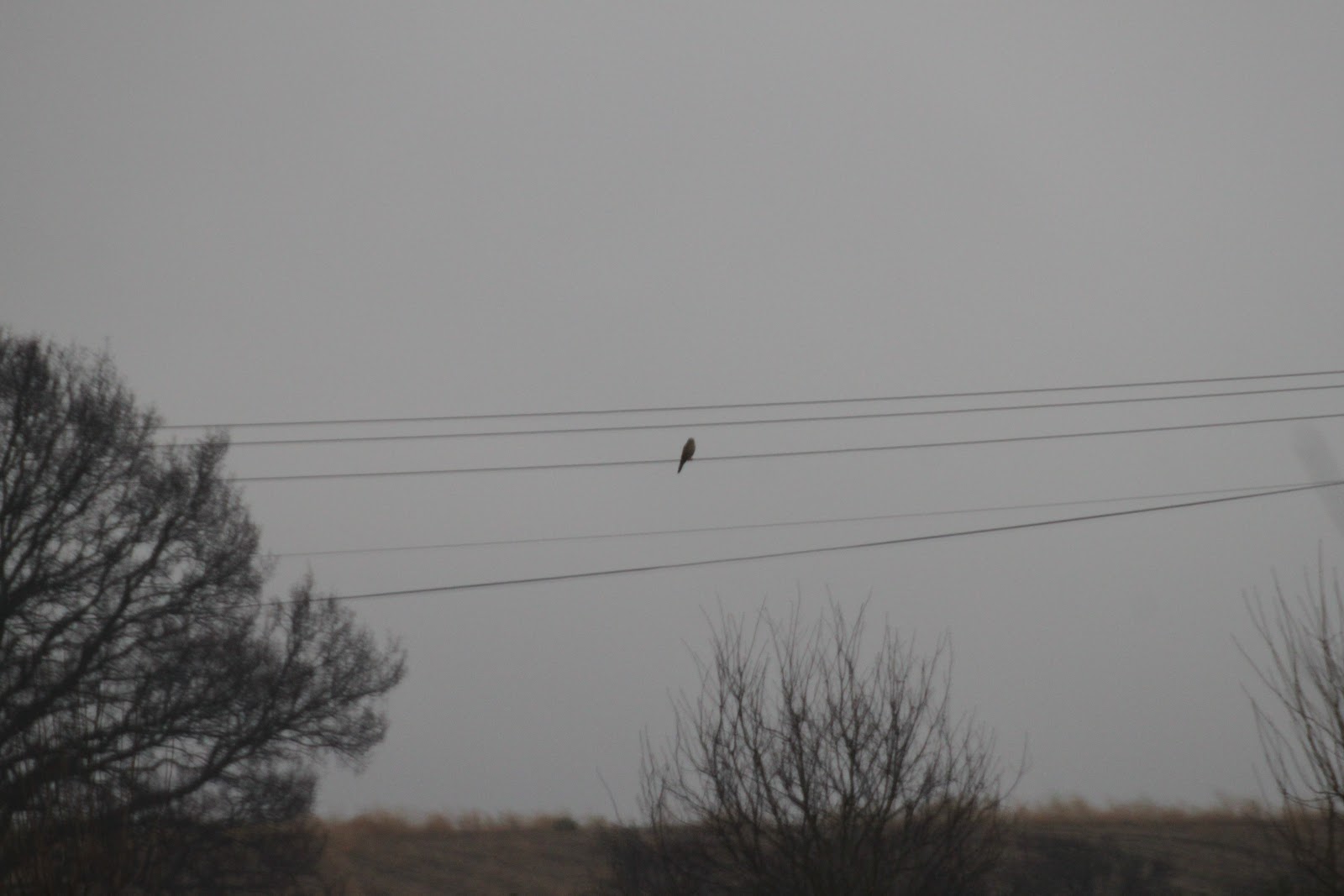 Falcons never fly when you're watching them.
I look down momentarily and he's gone, slipping effortlessly away into the steel grey sky, his departure belied by the cloud of starlings he sends up to the south.
A grey heron rises with slow, languid, almost thoughtful flight and puts down again in the reeds on the far bank, only his head peering curiously back at me. His expression one of annoyance as if I had disturbed some long awaited table at Michelin starred restaurant.
I try to use the cover of some autumn-stripped branches to approach, but a crack of a branch and a splosh of a boot in a puddle and he's away again, another 300 yards south, and into deeper reeds. He croaks his sore-throated anger at me, and disappears from view.
I climb back up to the flood bank, where the old canal lock used to allow the barques onto the river, and pick up a kestrel, low behind the leafless shrubs that form the shore of the flooded part of the meadows, he rises, hovers, shifts east then west slightly, drops, hovers then plummets from the sky and I lose sight.
Beneath my feet, a pile of neatly plucked moorhen feathers and a few bones glisten in the rain. A falcon has fed here recently.
I start to retrace my footsteps, tiring of the rain, and he's there again. I see the peregrine glide into the tree, and turn to watch me. He hops along sideways, then stiffens. I seek a tree to break up my shape and watch, and wait.
He rises, and heads straight for the flood waters, climbing slowly, sending up great clouds of waders and ducks, before circling higher into the slate-grey sky and disappearing. After I while I turn back to glass his tree and he's there; as if he'd run the ducks just for fun. I left him sat there, fluffed up against the rainy..
Subscribe to:
Posts (Atom)